
Category: Government & Civic Technology, Public Health, Flutter, Field Data Collection Tags: #GovtApp #WBPHED #PublicHealth #CivicTech #FlutterGovt #WaterQualityMonitoring #DataGovernance
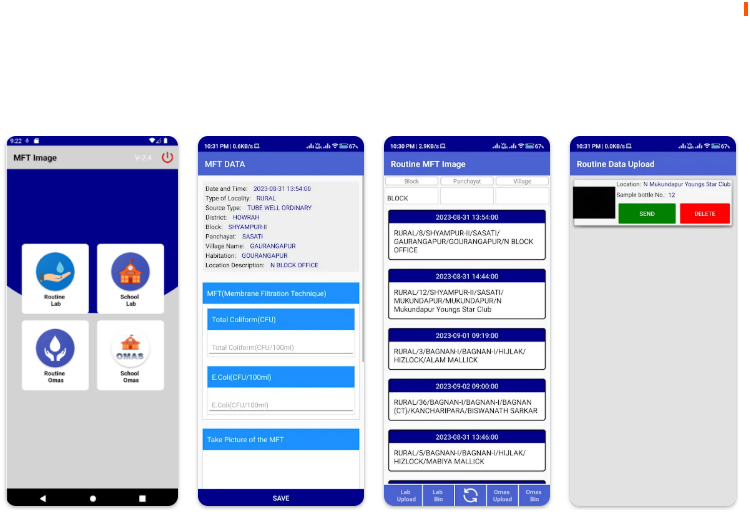
Introduction: Mobilizing Public Health Infrastructure
The Public Health Engineering Department (PHED) of the Government of West Bengal has the critical mission of ensuring safe drinking water for its citizens. To effectively monitor thousands of public water sources (wells, tube wells, community taps) and track essential chemical properties (like Arsenic, Fluoride, and Chlorine), a robust mobile solution was essential.
The WBPHED Field Data Collection App was developed using Flutter. Our goal was to create a tool that is highly reliable for field use, ensures data integrity, and provides direct, instantaneous reporting to central government databases.
🛠️ Project Summary & Technology Stack
| Detail | Description |
| Product | WBPHED Water Source Monitoring App |
| Role | Senior / Lead Flutter Developer |
| Technology | Flutter (Dart), GIS/Location Services |
| Key Features | Geotagged Data Entry, Chemical Parameter Recording, Offline Data Sync, Direct Reporting to Government ERP/MIS |
| Platform | iOS & Android (Unified Codebase) |
The Core Challenge: Ensuring Data Integrity in the Field
The primary technical and operational challenge was to guarantee that critical public health data—the chemical composition and status of a water source—is captured accurately, tied to the correct location, and reliably transmitted to the central government servers.
1. Geotagging and Source Verification
- Problem: Field workers must accurately confirm the location of the water source to link the chemical data to the correct asset in the GIS (Geographic Information System) database.
- Solution/Implementation:
- Implemented mandatory GPS-based location stamping for every data submission. The app reads the device’s location using Flutter’s location services and includes the latitude/longitude in the payload.
- Used visual feedback to show the field worker their current location relative to known assets, reducing human error.
2. Structured Chemical Parameter Recording
- Problem: The app must support the systematic entry of complex chemical readings ($\text{As}$ for Arsenic, $\text{Cl}_2$ for Chlorine, $\text{F}$ for Fluoride, etc.) as determined by field testing kits.
- Solution/Implementation:
- Designed custom form widgets specifically for parameter entry, ensuring units (e.g., $\text{ppm}$ or $\text{ppb}$) are clearly displayed and data types are validated (only numbers accepted).
- Implemented critical value alerts within the app: if a field worker enters a reading (e.g., Arsenic concentration) that exceeds the permissible safety limit, the app instantly flags the entry and requires mandatory photographic evidence or notes, prioritizing the source for follow-up action.
3. Direct, Secure Government Reporting
- Problem: Data must move seamlessly and securely from the field to the central government MIS (Management Information System) or ERP for immediate review by administrators and policy-makers.
- Solution/Implementation:
- Developed a highly secure, authenticated API client to interface with the PHED’s central database.
- Ensured all data is encrypted in transit (HTTPS/TLS) to comply with government security standards.
- Implemented a reliable offline queuing system where data collected in remote areas (with poor connectivity) is stored locally and automatically synchronized as soon as a network connection is available, ensuring no data is lost.
🔑 Technical Highlights and Societal Impact
- High Data Integrity: Mandatory GPS stamping, photographic evidence, and validation rules ensure the reliability of public health data.
- Real-Time Governance: Provides administrators with instant data on sources exceeding safety limits, enabling rapid intervention and resource allocation.
- Cross-Platform Efficiency: Delivered a standardized, high-performance tool for all PHED field personnel across different devices using a single Flutter codebase, simplifying deployment and training.
Conclusion: Civic Technology for Safer Communities
The WBPHED app is a powerful example of using Flutter for critical civic technology. It directly supports public health outcomes by mobilizing the data collection process, turning manual readings into real-time, actionable intelligence for the Government of West Bengal.
If your governmental or public sector organization requires a secure, reliable, and geo-enabled mobile application for critical field operations and data governance, our expertise in building these specialized Flutter solutions is proven.
🔗 Explore the Live Application: