
Category: Government & Civic Technology, Public Health, Flutter, Field Data Collection Tags: #FlutterGovt #WBPHED #PublicHealth #FieldTestKit #DataIntegrity #WaterQualityMonitoring
Introduction: The Digital Backbone for Water Safety
The reliable monitoring of public drinking water sources is a matter of life and death. The Government of West Bengal’s Public Health Engineering Department (PHED) requires thousands of field workers to test water sources for contaminants like Arsenic, Fluoride, Iron, and Chlorine using portable Field Test Kits (FTKs).
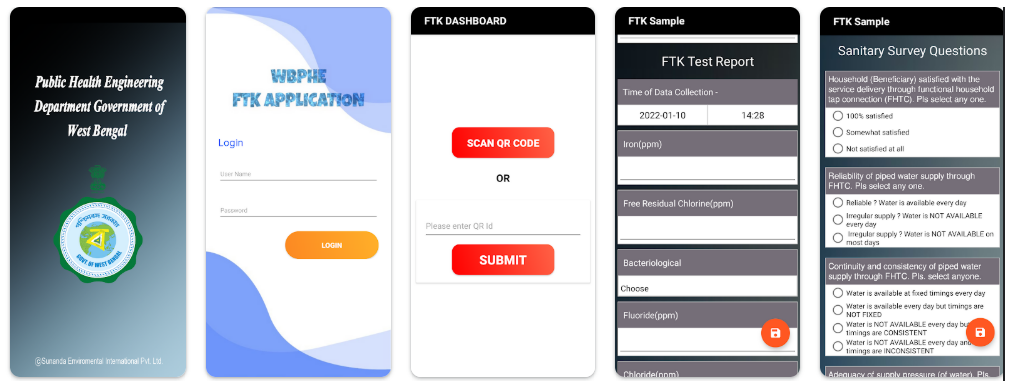
The WBPHED FTK Application (com.sunanda.ftk.ftkapplication) was built using Flutter as the essential mobile conduit for this data. It transforms manual test results into real-time, geotagged digital records, serving as a critical component of the state’s Water Quality Monitoring and Surveillance (WQMS) system.
🛠️ Project Summary & Technology Stack
| Detail | Description |
| Product | WBPHED Field Test Kit (FTK) Data Uploader |
| Role | Senior / Lead Flutter Developer |
| Technology | Flutter (Dart) |
| Key Features | Mandatory Geotagging, Structured Parameter Forms, Offline Submission Queue, Role-Based Authentication |
| Platform | iOS & Android (Unified Codebase) |
The Core Challenge: Ensuring Reliable, Actionable Data from the Field
The app must function flawlessly in remote rural areas with poor connectivity and guarantee that the data captured is accurate and instantly actionable for public health administrators.
1. Data Accuracy and Geotagging
- Problem: Data integrity is paramount for public health decisions. Every sample must be tied unequivocally to its source.
- Solution/Implementation:
- Implemented mandatory GPS capture for every test submission. The application utilizes Flutter’s location services, refusing to submit the record without a valid location stamp, thus verifying the location of the source.
- Designed a hierarchical Location Selection Module (District, Block, Panchayat, Village/Source) that automatically populates the location context . This ensures the test data aligns perfectly with the government’s existing administrative and geographical data models.
2. Structured Chemical Data Entry
- Problem: Field workers need a simplified, error-proof way to log multiple chemical readings ($\text{As}, \text{Cl}_2, \text{Fe}$, etc.) from the FTK.
- Solution/Implementation:
- Developed specialized numeric input fields for each water quality parameter. These fields enforce data type validation and clearly display the required unit (e.g., $\text{mg}/\text{L}$ or $\text{ppm}$).
- Integrated instant validation alerts that warn the user if a reading exceeds a defined health threshold (e.g., an unsafe level of Arsenic), prompting a mandatory note or follow-up flag, which elevates the alert to the central dashboard.
3. Offline Submission and Direct Integration
- Problem: Data must reach the central Water Quality MIS/Dashboard despite the sporadic connectivity in field locations.
- Solution/Implementation:
- Implemented a robust Offline Data Queue. If the internet connection is lost, the submitted data is securely stored locally.
- A Synchronization Service constantly monitors network status and automatically pushes the queued data packets to the central government servers the moment connectivity is restored. This ensures 24/7 data collection capability without data loss.
🔑 Technical Highlights and Governance Impact
- Civic Responsibility: Directly enables the government’s monitoring programs, supporting major national missions aimed at providing clean drinking water.
- Audit Trail: Mandatory location and time stamps create a verifiable audit trail for every test conducted, improving accountability of field staff.
- Centralized Intelligence: The immediate digital upload allows central PHED authorities to view the FTK Summary and unsafe results in real-time, enabling prompt remediation action.
Conclusion: Expertise in Mission-Critical Systems
The WBPHED FTK Application showcases our profound expertise in developing mission-critical, high-integrity applications for the government sector. This project required more than just coding; it demanded solutions for security, geographic accuracy, and operational continuity in challenging field environments.
If your governmental or public health agency requires a specialized, robust mobile solution for data collection and monitoring, our experience with the PHED framework is ready to deliver.
This video provides context on the importance of the technology used in this application: What is FTK water testing?.