
Category: IoT & Industrial Solutions, Flutter, Environmental Tech, Data Visualization Tags: #FlutterIoT #WaterQuality #EnvironmentalTech #IndustrialApp #DataMonitoring #Sensors
Introduction: The Critical Role of Mobile Monitoring
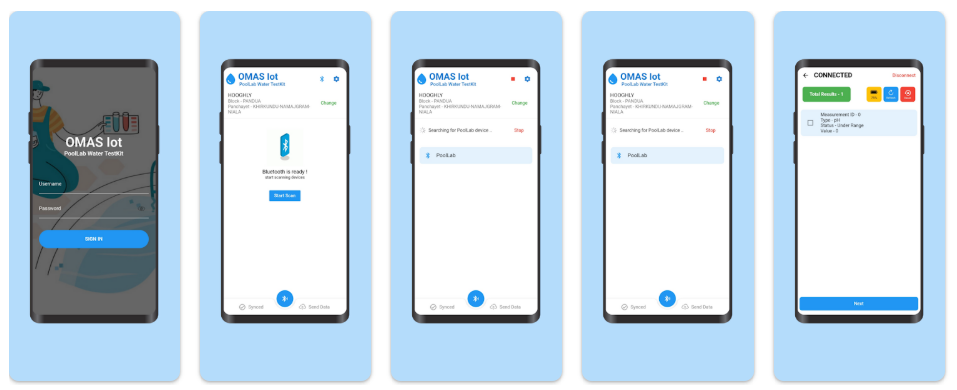
In environmental and industrial settings, accurate and real-time water quality data is critical. The OMAS IoT app, developed for Sunanda International, serves as the essential mobile interface for their specialized water testing devices. This application is not just a dashboard—it is a secure tool that connects physical sensors to digital data, providing immediate and actionable insights to field technicians and environmental engineers.
We utilized Flutter to build this application, prioritizing speed, data security, and the ability to handle complex data streams from industrial IoT devices across both Android and iOS platforms.
🛠️ Project Summary & Technology Stack
| Detail | Description |
| Product | OMAS IoT Water Testing App |
| Role | Senior / Lead Flutter Developer |
| Technology | Flutter (Dart) |
| Key Integrations | IoT Communication Protocols (e.g., MQTT, HTTP API), Secure Data Encryption, Location Services, Image/Media Capture |
| Platform | iOS & Android (Single Codebase) |
The Core Challenge: Reliable Data Ingestion and Visualization
The primary technical hurdle was creating a robust system that securely ingests high-frequency data from specialized water quality testing devices and presents it in a clear, actionable format for professionals.
1. Secure IoT Data Ingestion and Handling
- Problem: Data from industrial sensors must be transmitted securely and reliably to the mobile client, often over varied network conditions.
- Solution/Implementation:
- Implemented robust API clients within the Flutter application to communicate with the OMAS IoT backend.
- Ensured data is encrypted in transit (as noted in the app details), utilizing HTTPS and potentially secure MQTT protocols, to maintain data integrity and compliance.
- Designed the data flow using a Repository Pattern to efficiently handle and store collected data points (e.g., $\text{pH}$ levels, $\text{TDS}$ readings) locally for offline use, syncing when connectivity is restored.
2. Professional-Grade Data Visualization
- Problem: Raw sensor data is useless to an engineer; it must be visualized and contextualized.
- Solution/Implementation:
- Developed custom charting and graphing widgets in Flutter to display historical trends and real-time readings of various water parameters. * Implemented a clear visual Alerting System (color-coded gauges and notifications) to flag any readings that fall outside defined acceptable parameters, enabling technicians to prioritize intervention.
3. Field Data & Context Capture
- Problem: Field testing requires capturing context (location, visual evidence) alongside the sensor readings.
- Solution/Implementation:
- Integrated Location Services to automatically geotag where each water test sample was taken, providing crucial context for spatial analysis.
- Implemented secure access to the device camera and photo gallery to allow users to upload visual proof or documentation related to the test site, ensuring complete record-keeping for every assessment.
🔑 Technical Highlights and Business Value
- Environmental Compliance: The app provides traceable, verifiable records of water quality testing, which is essential for industrial environmental compliance and reporting.
- Security & Encryption: The focus on data security (encryption in transit) is paramount, protecting sensitive environmental and operational data.
- Simplified Workflows: By combining data logging, visualization, and documentation into one mobile tool, the app significantly streamlines the workflow for field technicians, reducing errors and saving time.
Conclusion: Expertise in Specialized IoT Applications
The OMAS IoT app stands as a testament to Flutter’s viability in highly specialized and demanding sectors like environmental monitoring and industrial IoT. It required not just mobile development skills, but a clear understanding of data protocols, security requirements, and the specific needs of a professional field user.
If your enterprise requires a custom mobile interface to control, monitor, and visualize data from proprietary sensors or industrial hardware, this project showcases our capability to bridge that gap effectively.
🔗 Explore the Live Application:
- Google Play Store: https://play.google.com/store/apps/details?id=com.sei.poollab.sei_pool_lab